THE RAW NUMBER
- Around 4 titles appear at the beginning of the film
- The time titles last can be often as long as 4 minutes or as short as 20 seconds
THE SPECIFIC WORDING + ORDER
- When a title refers to a company, it will present that company with 'In association with Company X' or 'Company X presents'
- When presenting the director, the wording is usually 'A film directed by Director X', however if the director is an auteur the wording is 'A Director X film'
- Actors are often listed using ' Introducing' however if the film is a star waggon 'starring' or 'featuring' is more common
- Films often go company, director, then actors however this changes depending on several factors. An example is if the director is an auteur, their title is more often first. This is a similar circumstance to films that are star waggons.
DESIGN
- The style of the titles usually is based around the genre, similar to points like the title colour and font.
- Serif fonts are often used in genres such as romance, drama, social realist, horror, slasher and thriller. Serif fonts tend to signify a more serious film. Where as fonts that are Sans serif are used for genres like action and comedy, as they can be impactful or simple
- Depending on the importance of the title, such as a 'starring' title, or an auteur title, the font size will be bigger and tend to stand out more.
- Whether the title is uppercase or not depends, as it can be used to bring focus to the title, however it doesn't fit with some genres such as Romance
- The colour of the title is most commonly white, as it can be used with most genres if not all, in combination with the font. It also allows important titles like star or auteur to be further highlighted by having them on a black background ( a common background )
FX, ANIMATION
- Non-diegetic titles are titles that are added post production and often move through the scene all though don't effect, just look cool. An example of this is in Zombieland
- Equally there are also diegetic titles that are in the scene that actors could touch or see in real time.
- Often titles just fade out, however different title transitions are also based around genre, so that they fit better with the film.
Showing posts with label auteur. Show all posts
Showing posts with label auteur. Show all posts
Wednesday, 20 November 2019

Friday, 13 September 2019
THEORY the auteur theory
-The auteur film theory is related to a director with a distinct style E.G( Quentin Tarantino).

Tarantino’s common choice of themes and his use of mis en scene show his distinctive style. In almost all of his films he writes the film, and is usually involved in the production of his films as well.
Tarantino also focuses on social issues as he often portrays the reality of social structures in his films, often having the protagonist as the underdog, and then appear strong and willing to take revenge on the antagonist of the film.
Therefore, Tarantino is a classic auteur as, similar to Meadows, he has all the characteristics of an auteur director in his films.
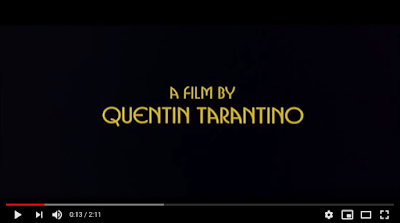
Following exactly the same logic as with Shane Meadows, we can denote a title that contrasts to the background as it is yellow on black,
with a directors name in a larger font, center screen
The contrast of colour suggests importance, as well as the font size difference, highlighting the name of the director. As well as this, we can connote, using the rule of thirds, that this title is of importance.
'A film by' again gives all credit to the director
-It covers social issues looking at film as an art form instead of a money making device.
-It assumes the director is THE creator of the film taking away credit to writers, producers and editors.
RICHARD CURTIS, A COUNTER EXAMPLE?
A film director, writer and producer for films who focus on the comedic relief in romcoms instead of focusing on social issues and important topics, and does the opposite by disguising those topics to the general audience. However is very successful commercially, and he has very distinct writing in a film
Is Richard Curtis an auteur, is a complicated question because he fits the description of having a distinct style with the films he makes. However he doesn't fit the point that an auteur portrays social issues and topics. The next point is that he works mainly on romcoms, which is a female based film and arguably, just like soap operas, woman's magazines are generally seen as trashy.

SHANE MEADOWS
Shane Meadows is a film director, as well as a writer and actor, and finally also a producer. He often focuses on social realist movies, working with smaller indy companies, mainly Warp Films, to create cinematography that focuses on social issues, unlike the usual romcom seen in cinemas. Shane Meadows has a very distinct style in his film making with key points such as a working class protagonist with complex motives, along with his default social realist genre.
Meadows is a classic example of an auteur director as he hits every key characteristic. Firstly all of his films make a social statement, often about the working class, juxtaposing the common stereotype of working class characters in conglomerate film media, where the character is often the dumbest character, Meadows gives the character a complex meaning (an example being Dead Man's Shoes). This is again reinforced by his choice of social realist movies. Almost all of his films have won cinematography awards as well as good reviews, because of the film being a piece of art.

Meadows is a classic example of an auteur director as he hits every key characteristic. Firstly all of his films make a social statement, often about the working class, juxtaposing the common stereotype of working class characters in conglomerate film media, where the character is often the dumbest character, Meadows gives the character a complex meaning (an example being Dead Man's Shoes). This is again reinforced by his choice of social realist movies. Almost all of his films have won cinematography awards as well as good reviews, because of the film being a piece of art.

Finally in the beginning of This is England, during the title sequence, the title 'a SHANE MEADOWS film' is shown, which is a trait-mark of an auteur director, as it gives the director credit for the film, instead of equal credit to also the writers, producers and editors
It also highlights the name, as the font is bigger, once again suggesting that this is the biggest contribute to the creation of the film
It also highlights the name, as the font is bigger, once again suggesting that this is the biggest contribute to the creation of the film
- low budget films
- talks about social issues
- complex working class protagonist characters
- clear style to his films
- not big in box office
- film in the form of art
- social realism main style
- hybrid with some films like social realist and psychological thriller
Quentin Tarantino, a classic auteur
Tarantino’s common choice of themes and his use of mis en scene show his distinctive style. In almost all of his films he writes the film, and is usually involved in the production of his films as well.
Tarantino also focuses on social issues as he often portrays the reality of social structures in his films, often having the protagonist as the underdog, and then appear strong and willing to take revenge on the antagonist of the film.
Therefore, Tarantino is a classic auteur as, similar to Meadows, he has all the characteristics of an auteur director in his films.

Following exactly the same logic as with Shane Meadows, we can denote a title that contrasts to the background as it is yellow on black,
with a directors name in a larger font, center screen
The contrast of colour suggests importance, as well as the font size difference, highlighting the name of the director. As well as this, we can connote, using the rule of thirds, that this title is of importance.
'A film by' again gives all credit to the director
Subscribe to:
Posts (Atom)